
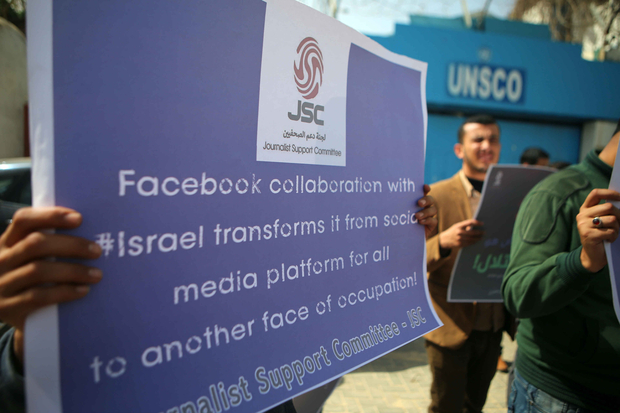
Journalists in Gaza protested on Monday against what they called Facebook’s policy of targeting Palestinian activists.
The rally, organised by the Journalist Support Committee (JSC) and held outside of the UNESCO headquarters in Gaza City, was aimed at highlighting what Palestinian activists call discriminatory targeting by the social media giant, often at the behest of Israel.
Salah al-Masri, the chairman of the JSC, accused Facebook of being biased in favour of Israel, and regularly deleted and blocks the pages of Palestinian account-holders.
"It is very regretful to witness Facebook’s acts against the Palestinian cause, by blocking and deleting social media activists’ accounts and Palestinian pages without any previous warnings,” he said.
"Facebook is a social platform that promotes communication between communities and their news and culture. However, today, it is a security platform that serves the Israelis,” Masri added.
Targeting the pages of Palestinian activists in such a way, he said, allows Israel’s narrative to dominate the global discussion, while it silences Palestinian voices. And the campaign has only intensified since the US announcement in December that it was recognizing Jerusalem as Israel’s capital.
"The JSC and human rights organisations will launch lobbying and advocacy campaigns to make Facebook regret its biased policy, as such acts are clearly against the Palestinian cause, and only serve the Israeli occupation,” Masri said.
Monday’s protest, he said, was aimed at making people aware of Facebook’s targeting of Palestinian activists, and to call on the California-based company to reopen the pages and accounts it has closed.
The recent increase in the closure of Palestinian activists’ Facebook pages and accounts has occurred in tandem with civil protests in Gaza and the West Bank against US President Donald Trump’s Jerusalem decision, activists say. Muthana al-Najjar is a Gaza-based journalist and activist on social media.
Since Trump’s announcement, Najjar has been banned from posting on Facebook four times.
After his first ban, which lasted thirty days, he was banned again for seven days in mid-January, and then for three days at the beginning of February and then a further 30 days in late February, the latter after he published a live video asking for the release of a Palestinian detainee from Israeli prison.
Najjar has more than 100,000 followers on his Facebook page, and is the third most influential Palestinian activist on social media, according to Pal Tweet, a Palestinian news site that focuses on social media.
After this spate of temporary bannings, he is now concerned that he might be permanently thrown off the site, as he continues to post news about Palestinian human rights issues.
"I am afraid that I may lose my followers who trust my news and posts through permanently deleting my Facebook account," Najjar said.
Palestine Net, Ishraqat Magazine, Palestine 27, Palestine Plus, Jerusalem, and Jenin Mix pages have all also had their Facebook pages closed permanently.
The pages of Ali Nasman, Ahmed Jarar, and Hassan Isleih, both journalists and social media activists, were also targeted by this discriminatory policy, they say. Together, they have thousands of followers around the world.
Sada Social Media Center, which tracks violations against Palestinian content on Facebook, has recorded 500 such violations since February, with 100 pages closed down and 70 accounts suspended, all of which advocated for the Palestinian cause.
"Since the Trump declaration, Facebook monitoring has increased on Palestinian pages,” said Iyad Rifai, Sada’s coordinator.


